Orchestrating High-Performance RAG Pipelines: Ingestion, Chunking, & Vector Search
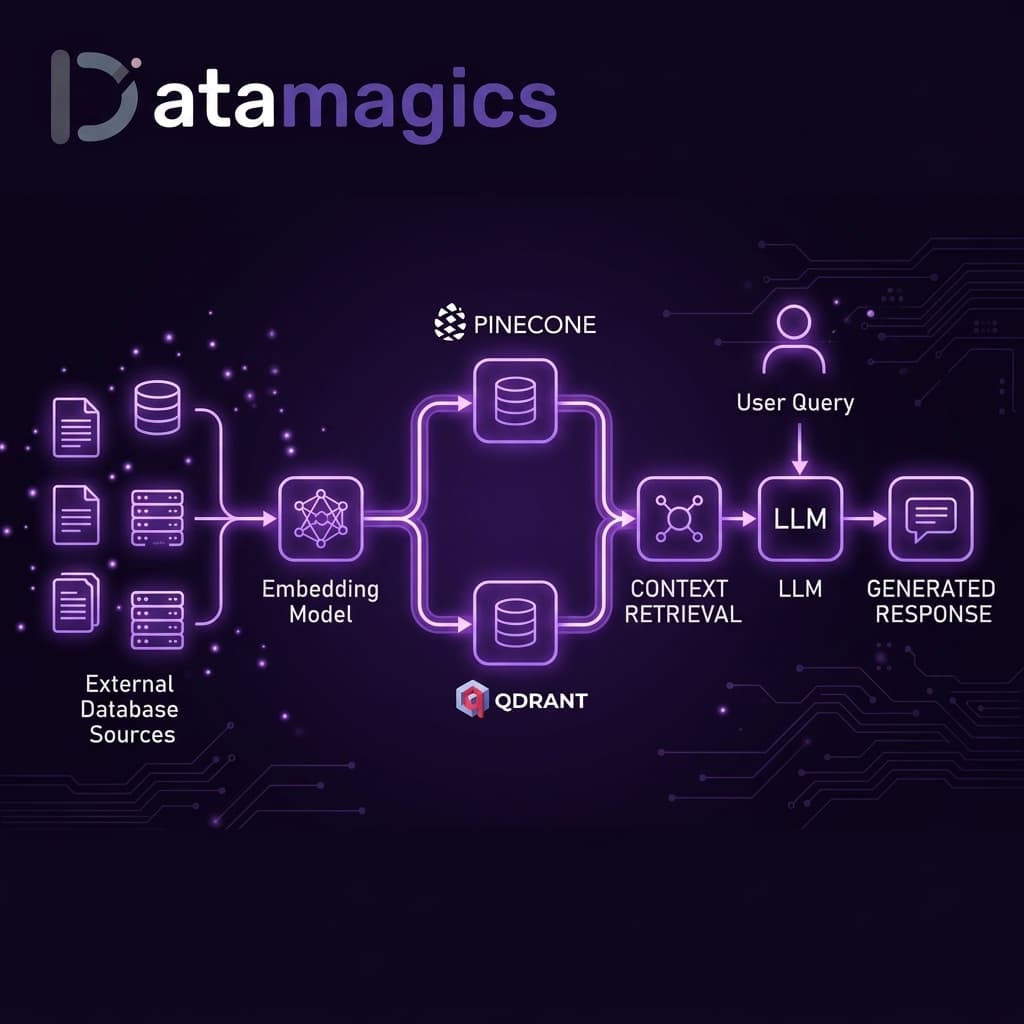
LLM Core Insights (TL;DR)
- 📌 Purpose: Simplify the setup of production vector embeddings indexing directly from SQL databases & files.
- 🚀 Integrations: Dynamic API connections for Pinecone & Qdrant database clusters.
- 🧠 Testing Hook: A built-in chat simulator sandbox enables real-time search query relevance validation.
Implementing Retrieval-Augmented Generation (RAG) is the industry standard for grounding Large Language Models in proprietary enterprise data. However, the data engineering required to pipeline unstructured text databases remains highly complex.
1. The RAG Ingestion Challenge
Traditional indexing methods involve writing rigid Python scripts, setting up manual cron triggers, and handling connection drops. The visual pipeline builder on **Datamagics.ai** changes this. By providing a node-based flow canvas, developers can connect source directories or live SQL instances, define custom chunking rules (e.g., character overlaps), and trigger automated sync runs in a single canvas.
2. Real-Time Vector Indexing
When documents flow through our pipeline, the engine splits content into structured chunks, generates high-dimension vector representations, and indexes them to vector databases like **Pinecone** and **Qdrant**. The visual canvas maps connections between:
- Sources: Local file folders (PDF, text) or relational databases.
- Processing Steps: Text parsing, token splitting, and metadata injection.
- Destinations: Vector databases containing semantic index vectors.
3. The Chat Playground Simulator
Building a RAG flow is only half the battle. Knowing whether the retrieval engine returns relevant chunks requires testing. Datamagics provides an **interactive chat playground** inline. Once your pipeline completes index synchronization, you can query your vector database directly in the dashboard, checking exactly which source chunks were retrieved and inspecting their semantic relevance scores.